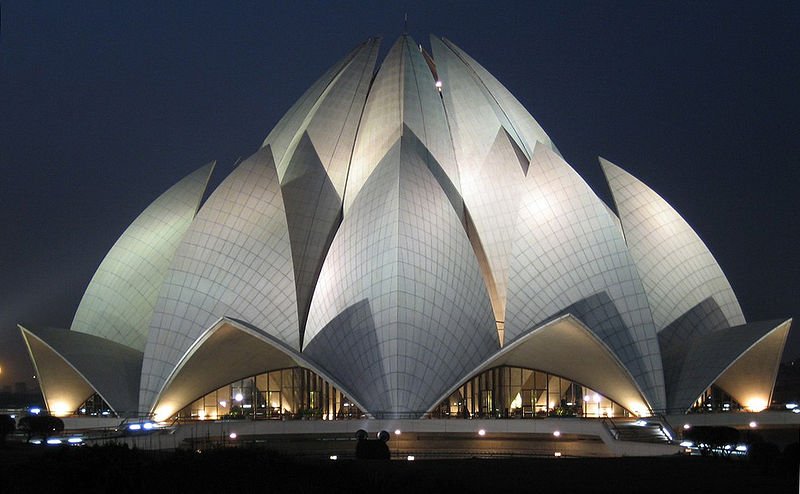
The Bahai House of Worship in Delhi, India, popularly known as the Lotus Temple due to its flowerlike shape, is a Bahai House of Worship and also a prominent attraction in Delhi. It was completed in 1986 and serves as the Mother Temple of the Indian subcontinent
Lotus Temple, Delhi
The temple gives the impression of a half-open lotus flower, afloat, surrounded by its leaves. Each component of the temple is repeated nine times. The temple is open to people of all faiths, languages and cultures. It is a symbol of a United India.
Why is it important to study Sociology in Architecture?
Sociology is an interesting subject which is very important in the study of Architecture. You must be wondering, why is it so important?
Sociology is the study of people… Socious means people and ‘logy’ means study. We “Architects” design spaces for the people to live in. We have the ability to create various types of environments… which serve different purposes.
Study of Sociology
Creating something for other people depends on the person’s choice, their culture. Architects are the masters that possess the ability to modify, transform and blend various design forms and cultures together. But to be able to do this, study of sociology is must.
Sociologists study how people act in a society and what others do to influence them. Sociologists need not necessarily be Architects but Architects have to be necessarily Sociologists…
For example:
Mother and Daughter
Friends
Many believe that there is a right way or wrong way of acting such as Putting up hands and not shouting.
Sociology studies what people believe ‘normal’ is. Considering a certain thing as normal depends on your society.
Casestudy, Analysis and Design Guide | Design Process of Major Bus Terminal for a Large City
Data Collection and Analysis
The site: Study and Analysis
Map of the City showing all the Transportation routes and networks
A Land survey of the exact boundaries
A topographical Map of the site
A Survey Map of all the Physical Elements on site such as Trees, Rocks, Peaks and Valleys, Water, Drainage, Electricity, High tension lines, low tension lines etc.
A Visual survey of the Surrounding Areas
Casestudy and Design of Bus Terminal
Building and Infrastructure – Study and Analysis
Surveys of the existing transportation Department
Size and Population of the City – A map
Size and capacity of the existing terminal
Maps showing existing traffic volumes and Travel Pattern
In state, Out of State, Types and categories of Buses etc.